Let’s be honest. If someone handed you a wedge of aged gouda and a steaming cup of coffee, your instinct might be to raise an eyebrow. Cheese and wine? Sure. Coffee and cheese? That’s… a new one.
But coffee is a fundamental part of my life. It’s not just a beverage—it’s a sensory experience, layered, aromatic, even ritualistic. I’m always seeking new ways to enjoy coffee in different contexts. And for me, enjoying it with cheese was a visionary experience—unexpected, yet deeply satisfying.
After all, both coffee and cheese are the products of time, transformation, and terroir. They’re alive with flavor, and when thoughtfully paired, they unlock something unexpectedly delicious.
This post isn’t about latte art or flashy cheese boards. It’s about chemistry and texture—the subtle dance that happens when bitter meets creamy, or when a bright citrusy coffee kisses the tang of a fresh goat cheese. Welcome to Part 1 of our exploration: flavor, feel, and the science of the surprising.
A Curious Chemistry
To understand why coffee and cheese can work so beautifully together, we have to consider the building blocks of taste: fat, acid, salt, bitterness, and umami.
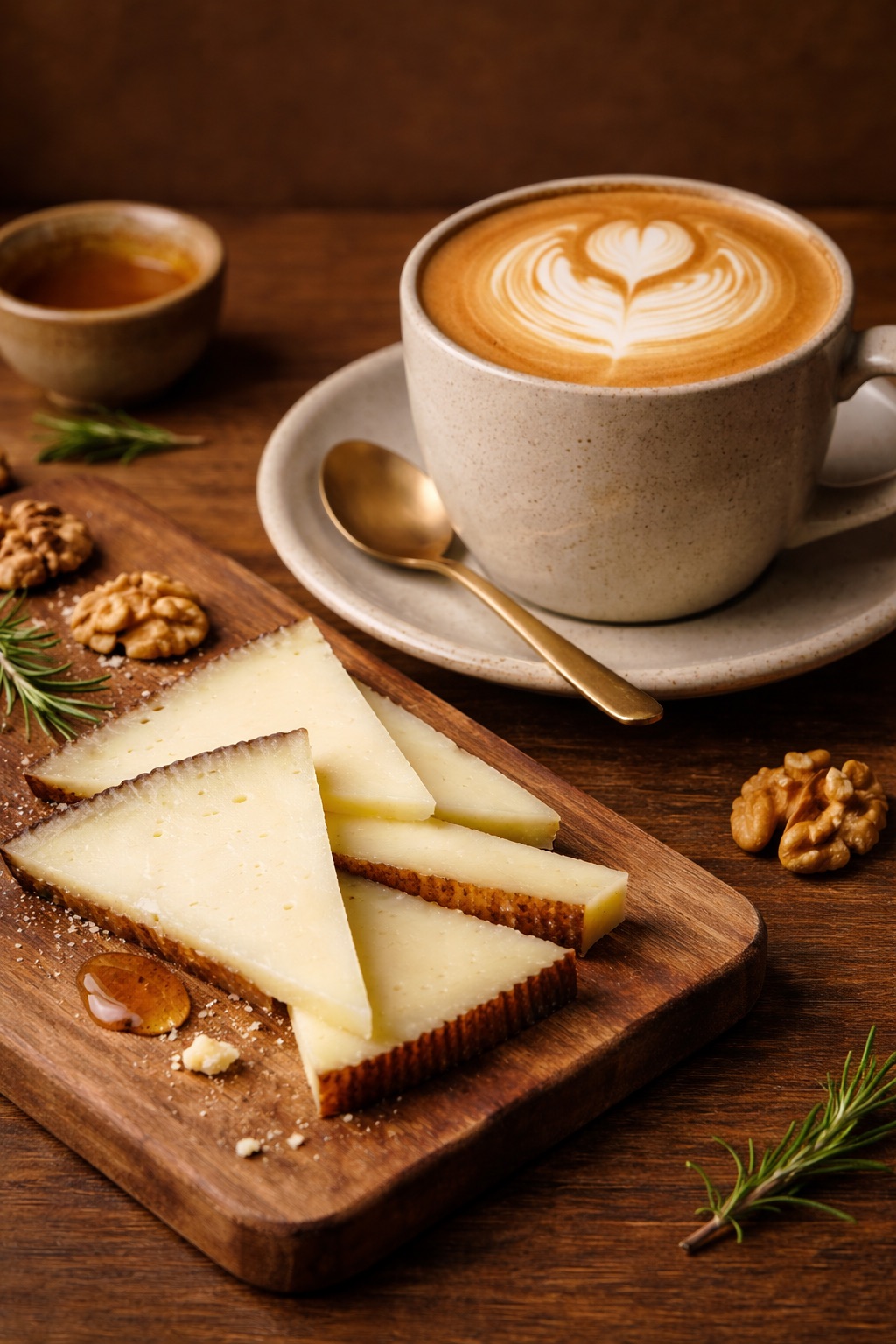 One of my favorite pairings—simple, yet unforgettable—is a flat white with Manchego cheese. The espresso’s rich, roasty depth plays against the sharp, nutty profile of the cheese. Somehow, they don’t compete—they cooperate. The nuttiness of the Manchego softens the espresso’s intensity, and the cheese, in turn, seems to melt a little, becoming rounder, more buttery, less insistent. It’s a dialogue between sharp and smooth.
At the core of this interaction is fat and bitterness. Cheeses—especially creamy or aged varieties—are rich in fat, which binds to the bitter compounds in coffee. That chemical bonding softens harsh edges, revealing unexpected layers of sweetness and warmth beneath the surface.
“Fats in cheese act as a buffer to coffee’s bitterness, enhancing sweetness and body.” — Food sensory principle (paraphrased)
Then there’s acidity, especially in bright, light-roasted coffees like an Ethiopian Yirgacheffe. That acidity cuts through rich, soft cheeses—like brie or camembert—creating balance and clarity on the palate.
And it works the other way, too. Cheeses with a touch of salt or tang—like a crumbly blue or a fresh goat—have the power to brighten mellow brews, especially cold brew or a smooth medium roast. It’s contrast and harmony, science and serendipity.
Texture Talks
Beyond taste, there’s something incredibly satisfying about how coffee and cheese feel together. Think of a silky espresso melting against the firmness of aged gouda. Or a cool, creamy brie playing off the dry mouthfeel of a floral Kenyan pour-over.
This is the kind of pairing that speaks in textures.
Crumbly cheeses—like aged cheddar—bring out the body of heavier brews. Lighter cheeses with a mousse-like quality, such as fresh ricotta, highlight the brightness of high-acid coffees. Even the serving temperature matters. A soft cheese at room temp unlocks flavors you simply won’t find if it’s fridge-cold.
And yes, I tried melting the brie once. (Spoiler: it paired better with a hot flat white than a black Americano.)
Brewing, Serving, Savoring
We can’t talk about pairings without talking about how things are made and served. Because the same cheese–coffee combo can change dramatically depending on how each is prepared.
Take the coffee. A cold brew is smooth, low-acid, sometimes chocolatey—great for pairing with funky or salty cheeses like blue or feta. A light roast pour-over? Delicate, citrusy, almost tea-like. It needs a cheese that won’t overpower it—perhaps a chilled goat’s cheese or a sliver of soft camembert. And then there’s espresso: bold, bitter, intense. It calls for equally strong companions—think aged gouda, mature cheddar, or even parmigiano with a touch of honey.
On the cheese side, serving temp is key. Letting cheese rest at room temperature for 30–45 minutes opens up its texture and aroma—just as grinding fresh beans enhances your brew. And don’t be afraid to play. Try warming up a slice of brie, or layering some ricotta on toasted sourdough with a side of espresso. These aren’t formal pairings—they’re sensory experiments.
The same piece of gouda can taste wildly different with a cold brew versus an espresso shot—especially if it’s been sitting out long enough to soften.
Try this at home
No need to host a full tasting flight—though that’s always fun. Just start small. Pick a couple of cheeses and a couple of coffees. Brew how you like. Slice up your cheese. Taste slowly. And notice:
- Does the cheese mellow or sharpen the coffee?
- Does the coffee change the feel of the cheese?
- Is something new emerging—a sweetness, a spice, a spark?
Here’s a starting point if you want inspiration:
- Ethiopian Light Roast + fresh goat cheese → bright and clean
- Colombian Medium Roast + gruyère or havarti → smooth and nutty
- Sumatran Dark Roast + aged gouda or blue cheese → bold and balanced
- Espresso + aged cheddar or manchego → sharp meets strong
- Cold Brew + blue cheese → funky meets mellow chocolate
But remember: it’s not about rules. It’s about discovery.
The final step
Coffee and cheese were meant to follow tradition—but their complexity thrives on pushing boundaries. They’re both the product of time and craft, of local landscapes and microbial magic. Pairing them isn’t about perfection—it’s about play.
Want to see the pairings in action? We’re experimenting with all kinds of combinations (some weird ones too)—hot, cold, creamy, sharp—and capturing it all in short videos. Follow us on Instagram, TikTok, or Youtube to watch the flavor stories unfold and get inspired to try your own:
Comments